Search This Blog

Tuesday, May 26, 2015

Bumbling Explorers


[I’ve adapted this commentary from delanceyplace.com, which itself was quoting Made in America, a book by Bill Bryson. It's kinda long, but I repurpose it here because I find it enjoyable and hope you will too.]

Various European explorers of the New World were woefully inept. Columbus never found Asia and really didn’t know where he was during the eight years he spent bouncing around the islands of the Caribbean. Giovanni da Verrazano was eaten by natives. Balboa, after discovering the Pacific, was betrayed by his colleague Francisco Pizarro and executed on trumped-up charges. Pizarro in his turn was murdered by rivals. Hernando de Soto marched an army pointlessly all over what is now the southeastern United States for four years until he caught a fever and died. 

The "Columbus Map," ca. 1490.
Scores of other adventurers went looking for wealth, eternal youth, or a shortcut to the Orient and mostly found misery. Their fruitless searches live on, sometimes unexpectedly, in the names on the landscape. For example, California commemorates a Queen Califia who was supposed to be unspeakably rich but unfortunately did not exist. Amazon denotes a mythical tribe of one-breasted women. Brazil and the Antilles recall fabulous, but also fictitious, islands.

English explorers fared little better. Sir Humphrey Gilbert perished in a storm off the Azores in 1583 after trying unsuccessfully to found a colony on Newfoundland. His half-brother Sir Walter Raleigh, attempting to establish a settlement in Virginia, lost a fortune and eventually his head in the effort. Henry Hudson pushed his crew a little too far while looking for a northwest passage and found himself put to sea in a little boat, never to be seen again. 

The endearingly hopeless Martin Frobisher explored the Arctic region of Canada, found what he thought was gold, and carried fifteen hundred tons of it home on a dangerously overloaded boat only to be informed that it was worthless iron pyrites. Undaunted, he returned to Canada, found another source of gold, carted thirteen hundred tons of it back, and was informed by a presumably weary royal assayer that it too was worthless. After that, we hear no more of Martin Frobisher.

It is interesting to speculate what these daring adventurers would think if they knew how whimsically we commemorate them today. Would Verrazano think being eaten by cannibals a reasonable price to pay for having his name attached to a toll bridge between Brooklyn and Staten Island? De Soto found brief fame in the name of an automobile; Frobisher in a distant icy bay; and Raleigh in a city in North Carolina, a brand of cigarettes, and a make of bicycle. 

By comparison, Columbus fared pretty well – a university, two state capitals, a country in South America, a province in Canada, and high schools almost without number, among a great deal else that bears his name. 

But in terms of linguistic immortality no one got more mileage from less activity than a shadowy Italian-born businessman named Amerigo Vespucci. How two continents came to be named in his honor involves an unlikely measure of coincidence and error. Vespucci did make some voyages to the New World, but always as a passenger or lowly officer. He was not, by any means, an accomplished seaman. Yet in 1504-1505, letters of unknown authorship began circulating in Florence, collected under the title Nuovo Mundo, that stated that Vespucci had not only been captain of these voyages but had discovered the New World.

The mistake would probably have gone no further except that an instructor at a small college in eastern France named Martin Waldseemuller was working on a revised edition of the works of Ptolemy and decided to freshen it up with a new map of the world. In the course of his research he came upon the Florentine letters and, impressed with their spurious account of Vespucci's exploits, named the continent in his honor. 

It wasn't quite as simple as that, however. At first he translated Amerigo into the Latin Americus, then transformed that into its feminine form, America, on the ground that Asia and Europe were feminine. He also considered, and rejected, the name Amerige. Even so it wasn't until forty years later that people began to refer to the New World as America, and then they meant only South America.

Source: Made in America: An Informal History of the English Language in the United States, pp. 7-9, by Bill Bryson. Publisher: William Morrow Paperbacks (1994).

Tuesday, May 12, 2015

Little Girl


Small person, large name.
Clover
   Gwendoline
     Reeve
       Feuillette

Little thing with
   huge potential.
A world of wonder your
   tiny hand holds.

First name, MI, Last name
   No form will hold you.
Stay within the lines?
   Never! Be yourself.

Unique. A “little leaf Clover.”
   My first grandchild.
I hold her and
   I hold the future. 


Thursday, November 13, 2014

When the Journey Matters Most


I have a love affair with trains. They’re comfortable, relaxing, and civilized. Compared to the cramped claustrophobia of air travel, trains are luxury made tangible. And there’s a certain romantic quality to them. Compare Murder on the Orient Express to “Snakes on a Plane” and you’ll understand what I mean.

San Diego station
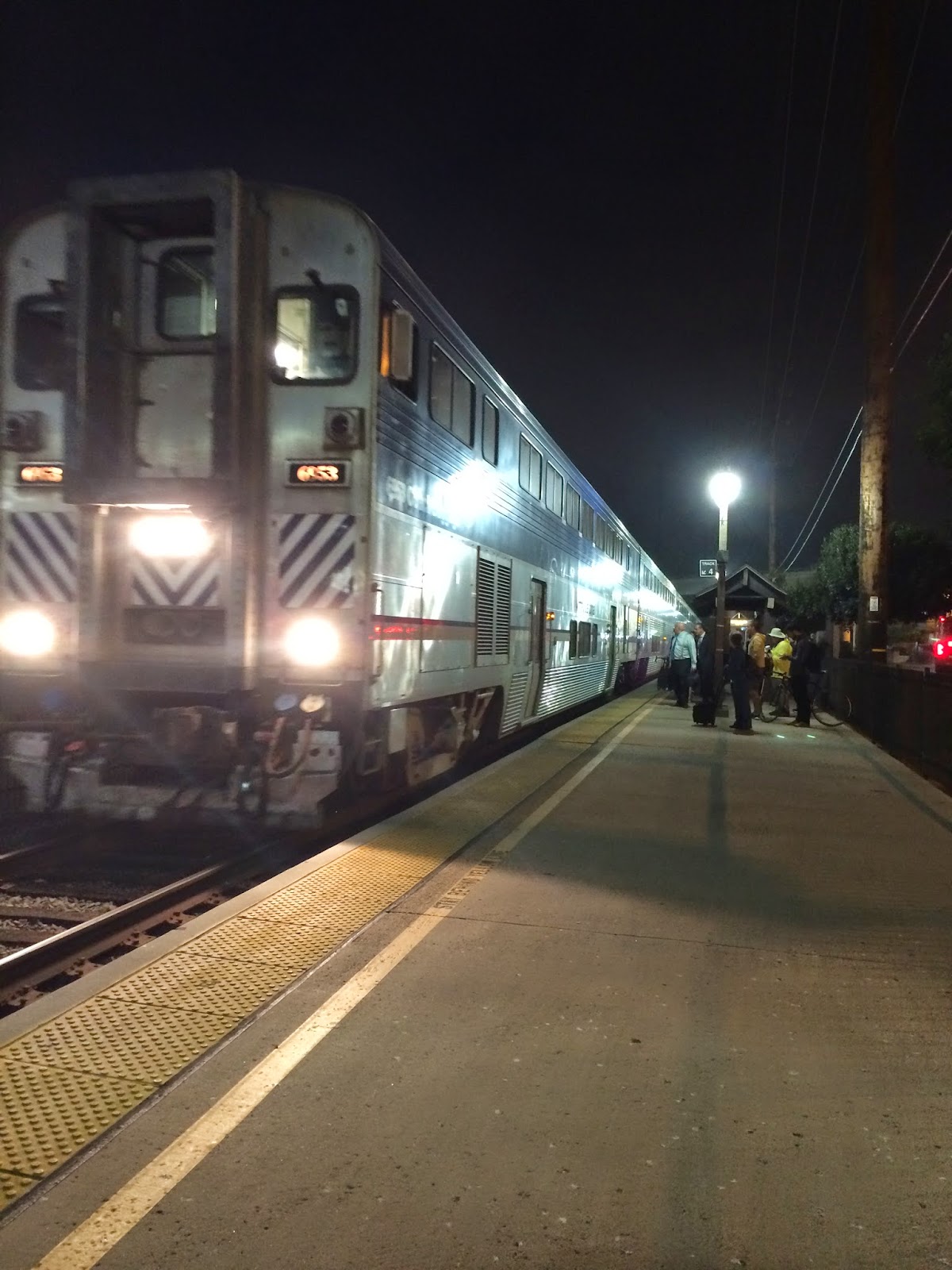
Last month I indulged my railway romance to travel from San Diego to Portland—a thousand-mile journey that began with the single step of getting from my apartment to the Amtrak station a mile and a half away. There, at about 6am on a Tuesday, I boarded the commuter train to LA.  

And because I had booked a sleeper compartment for the next leg, I spent a short layover in the first class lounge at Union Station. After about an hour a redcap drove us and our luggage to the platform where the Coast Starlight waited. At 10:10am it pulled out so gently and quietly you might not have known we were moving.


Lounge at Union Station
After stowing luggage in my room I checked out the three trailing cars: parlor car, dining car, and domed observation lounge. I reserved a seat for lunch and dinner (meals, ordered from the menu and served on good china, are included in the ticket price), and sat back to watch the California coastline roll by. The route took us past Mission Santa Barbara, through the wine country of Paso Robles, then on to San Jose and Oakland, stopping there about 10pm.

Sleeper car
Facing seats fold down
to make bed
Dining
Parlor car
Observation car
Mt. Shasta from a postcard (it
was overcast when we passed)
When we passed Sacramento at midnight I was comfortably asleep in my room, but at 5am I saw Mt. Shasta roll by and stayed awake for the rest of the trip to watch the scenery: the high desert of Klamath Falls, the Cascades Range with its many tunnels, and finally north up the Willamette Valley from Eugene. We arrived in Portland about 4pm on Wednesday, just a few minutes behind schedule.


The purpose of this trip was a work-related conference and the weekend with son Scott in his new condo, but the journey mattered as much if not more than the destination. It was an adventure, an odyssey of discovery, something I’ll treasure in memory for many years.


Maya Angelou wrote of love that it “jumps hurdles, leaps fences, [and] penetrates walls to arrive at its destination full of hope.” One could say of the love of trains, it traverses valleys, climbs through high deserts, and negotiates tunnels to bring the joy of travel and a more relaxed way of viewing the world. ■


Klamath Lake
A rainbow greets me in Oregon

Friday, September 26, 2014

Whittier, Faulkner and Coleridge Walk Into a Bar


I had lunch with some friends the other day, and one of them stared talking about her past. She wishes things could have been different: a happier childhood, a more caring family, different lovers, better jobs, etc. etc. “What if, what if …” she wondered over and over. “If only this. If only that.” Waaah, waaah, waaah!

I don’t resonate with that attitude, and “poor me” doesn’t cut it, although I didn’t say so outright. Instead, an aphorism from John Greenleaf Whittier came to mind, so I quoted it: “Of all sad words of tongue or pen, the saddest are these: ‘It might have been.’”

This elicited a couple of “oohs” from the group, so after a pause … for dramatic effect, of course … I explained myself, saying something like: “I don’t regret the past, and there’s nothing I can do about it. It makes us who we are. We shouldn’t dwell on it but should learn from our experiences and move on.”

The Whittier quote comes from his poem “Maud Muller” about a beautiful young woman who, while harvesting hay, meets a judge from the nearby town. Each is smitten with the other, and each dreams of marrying and adopting the other’s lifestyle. He dreamed of becoming a gentleman farmer, and she longed to become a rich judge’s wife. In the end, with sublime irony, she marries a simple, uneducated farmer and he marries a woman who loves him only for his money. Both marriages are unhappy, and for the rest of their lives Maud and the judge reflect with remorse on what might have been. 

Whittier writes: “God pity them both! And pity us all / Who vainly the dreams of youth recall.” 

I think Whittier is saying that what makes it might have been the saddest of all words is not merely that Maud’s life could have taken a different turn but that she wastes so much emotional energy brooding over it. Woulda, coulda, shoulda. That’s an emotion even less useful than worry. At least a few of the things we worry about actually do happen. As for the things that might have been: they never did and never will.

I reinforced my point by quoting a line from William Faulkner. He famously wrote that for some people “the past is never dead; it’s not even past.” That is to say, for those people—like for Maud Muller—the past is a burden, old baggage, an albatross around their necks, and they’d be best advised to shed it and move on. [It’s not often that I can work three literary references into one short conversation—the third being the albatross from Coleridge’s The Rime of the Ancient Mariner—but that day I did.]

As my cousin Doug Smith writes in his book Happiness: The Art of Living with Peace, Confidence and Joy, “The past is a key to happiness ... because if we don’t resolve feelings about events in our past we can be so absorbed by remorse or anger that we fail to live in the present.”

Or as one might say more succinctly: Get over it!

# # #